Presented for exceptional commitment to competitive employment opportunities for individuals with intellectual and developmental disabilities.
The Johns Hopkins Howard County Medical Center
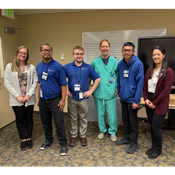
Johns Hopkins Howard County Medical Center merits recognition by The Arc Maryland for its sustained, systems-level commitment to advancing competitive, integrated employment for people with intellectual and developmental disabilities (I/DD) through two high-impact workforce initiatives: Project SEARCH and its partnership with Howard Community College’s Logistics Associate Program. Through its role as a host site for Project SEARCH, the Medical Center provides a fully immersive, real-world employment environment where young adults with I/DD participate in a structured, year-long transition program embedded within hospital operations. Interns rotate through multiple departments, gaining marketable, transferable skills aligned with actual workforce needs while building soft skills such as communication, time management, and workplace navigation. At Johns Hopkins Howard County Medical Center, this commitment is operationalized through staff engagement, mentorship, and integration of interns into daily hospital functions, moving beyond observation to meaningful contribution.
In parallel, the Medical Center extends its impact through participation in Howard Community College’s workforce training initiative targeting young adults with disabilities. As an industry partner in the Logistics Associate Program, the hospital hosts paid externships tied to industry-recognized credentials such as the Certified Logistics Associate (CLA) and Certified Logistics Technician (CLT). Participants receive both classroom instruction and hands-on experience in areas like inventory management, materials handling, and supply chain operations, functions that are critical within a hospital setting.
This dual engagement is significant for two reasons. First, it creates a continuum of opportunity: from high school transition (Project SEARCH) to postsecondary credentialing and employment pathways (HCC program). Second, it aligns disability inclusion with actual labor market demand. Healthcare systems like Johns Hopkins Howard County Medical Center, serving over 130,000 patients annually and employing more than 2,000 staff, require a range of entry- and mid-level roles that can be effectively filled through inclusive hiring pipelines. Rather than treating disability employment as a standalone initiative, the organization has embedded it into its workforce development strategy. By doing so, it reduces turnover risk, strengthens its talent pipeline, and demonstrates that inclusive hiring is both operationally viable and economically rational.
The Medical Center’s contribution leverages its scale, clinical environment, and community partnerships to create replicable pathways into competitive employment for people with I/DD. This level of integration, consistency, and measurable workforce impact distinguishes its efforts as worthy of recognition by The Arc Maryland.
Hagerstown Flying Boxcars
Today, The Flying Boxcars is recognized for the Employer Partner Award. Since opening, the ownership, management, and team have demonstrated a consistent commitment to inclusion, community engagement, and meaningful employment opportunities for individuals supported by The Arc of Washington County. Their partnership reflects the very best of what it means to partner with a local nonprofit.
With the support from The Arc of Washington County Employment Services team, The Flying Boxcars have embraced integrated employment opportunities for the people we serve in roles such as concessions, ticketing, and batboy. These are not symbolic positions—they are valued roles that contribute to the overall game-day experience and are paid according to the fair market. Management provides a supportive environment where individuals are treated as equal members of the team, fostering independence, confidence, and pride in their work.
Beyond employment, The Flying Boxcars have gone above and beyond to ensure people served by The Arc feel included in the life of the organization. On the Stadium’s opening day, ownership extended the honor of singing the national anthem to an individual supported by The Arc of Washington County — an unforgettable moment that set the tone for an inclusive culture from the very beginning. Each season, the team continues this spirit by inviting individuals to participate in special events such as Educational Day, Trick or Treating on the field, and other themed experiences.
The players and team mascot have also made multiple visits to The Arc’s campus, bringing excitement and joy to people who might not be interested in going to the ballpark. These visits are more than appearances—they are genuine efforts to build relationships and create shared experiences that matter deeply to the people we support as well as the team.
During The Arc of Washington County’s annual sponsorship night, The Flying Boxcars further continue their welcoming hospitality by providing opportunities for individuals to take center stage—singing the national anthem, leading the 7th inning stretch, and even throwing out the first pitch. These moments are powerful affirmations that individuals with disabilities belong in all aspects of community life.
The Flying Boxcars have clearly proven to be more than a community partner—they are champions of inclusion. But they continue to drive an inclusive environment, as noted by their most recent endeavor to create a sensory room at the stadium. Their actions consistently reflect a belief that everyone deserves the opportunity to participate, contribute, and be celebrated. As The Arc of Washington County continues to expand opportunities for community engagement and employment, they are proud to stand alongside an organization that shares their vision so fully. Both organizations have benefited from this partnership, but the greatest impact has been on the individuals who have been welcomed, empowered, and embraced. Through their leadership and example, The Flying Boxcars are helping to build a community where inclusion is not just encouraged—it is valued.